


by Ali Holcomb
The following article was written by Ali Holcomb, a member of BridgeWay who first published it through her blog “As I Write This…” at aliholcomb.substack.com.
Right now our Church is doing a series on Christian apologetics and it has been a mentally stimulating series. Every time we drive away on Sunday I find myself wanting to discuss the sermon with my husband. I think we as Christians have often grown up and been fed a delicious and rather fluffy diet of “good feelings” Christianity. That our feeling of being loved by a sovereign God can carry us through life. That feeling is often what makes you choke up during worship, coming to terms with being loved by God, an all-powerful, all-knowing being, it’s a beautiful spiritual “high.”
But feelings are not Truth, they are fickle and crumble, especially the harder life is. Children do not always “feel” loved by their parents, even when their parents are acting out of love in their best interest. But being loved does not mean getting what you want, and that juxtaposition will always come head to head in the Christian faith; God’s love vs human understanding.
A challenge of the sermon series is to not rely solely on our “feelings” to explain our faith. It’s all well and good to say you “feel God’s presence” but to most people they don’t know what that means, and to be honest, I’m not sure I have a full grasp on it either. There are intellectual questions that will be asked and I can’t retort with the good feeling I get being loved by God, because I do not always feel loved, nor does His love always feel particularly good to me.
The final question yesterday was “How would you explain to someone why there is no one like Jesus?” And I wrote “He is the center of history.” You see, the entire basis of human history is based on when he walked on Earth, BC (before Christ) and AD (Anno Domini, the year of our Lord). Of course some historians prefer to call it BCE (before common era) or CE (common era) but the dates don’t change, human history still hinges upon Christ, whether we acknowledge him or not.
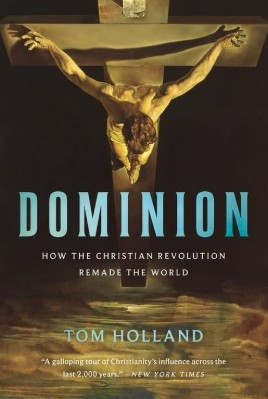
One of the books that has built up my faith the most in adulthood was a book that wasn’t even written to do so. Dominion by Tom Holland is a decisive history of Christianity and how it brought about the western world and the moral standards that are now commonplace. An atheist historian writing an honest assessment of Christianity can’t shy away from the fact that Christianity changed the world. A religion that changed the world so drastically must have something to it. Not a cult following where the followers were eventually rescued, but a religion throughout hundreds of years, in spite of human error and sin, kept growing, kept attracting people.
And it wasn’t that Christianity simply grew, but it gradually eroded the world as we know it. During Holy Week I read a lot about the brutality of crucifixion, because I realized I’d perhaps started viewing Christ’s death a little too tritely, and needed to come to terms with the depth of the Passion. After reading about Rome’s great love of torture and public deaths, I muttered to myself “how did we ever manage to move humanity away from such delight in brutality and torture?” And of course the answer is Christianity. That even those condemned are made in the image of God, deserving of compassion. The eighth amendment protects against “cruel and unusual punishment.” Because if “all men are created equal” it is not debatable, and creates a basis for a new set of laws and an underlying moral code for how to treat our fellow humans.
That Christ is the turning point of history can be no coincidence, nor will it ever be written out of human history. The existence of the person of Christ is a pretty well established historical fact, and I see no more reason to question his existence than question the existence of Nero, Cleopatra, Alexander, or Napoleon. And so if he existed you must make up your mind about him. Setting aside all the good feelings and mountain top moments I’ve had for years in my faith, I must take an honest look at the world around me and assess who Christ is.
A man who existed in such an ordinary form that it wasn’t immediately obvious to all who saw him that he was other worldly, and yet, he gripped humanity. If he really was insane, or lied about being God would we really have allowed all of human history to be based upon this man who had a decent following but then was crucified? Something about that seems lacking.
A God who sends his son to earth as a human, who saves humanity through what we all fear most, death, who works his will sometimes through his Church and his followers, seems to be the God who would also leave his stamp on all of human history. There was “Before Christ,” and there is “the Year of our Lord,” but our history will never exist outside of relation to the person of Christ. Most men are dates in history and nothing more, there is birth, a life, and then death, perhaps if a really great man or woman of history you get an era; Victorian, Napoleonic. But Christ, who walked the streets of Jerusalem, is the center of all history.